Missing a tooth can affect much more than the appearance of your smile. Over time, tooth loss may influence how you chew, how neighboring teeth fit together, and the health of the jawbone that once supported the missing tooth.
Fortunately, modern dentistry offers several effective tooth replacement options, including dental implants, dental bridges, and removable partial dentures. For many patients, dental implants offer one of the most stable and natural-feeling ways to replace a missing tooth.
If you have recently lost a tooth or have been living with a gap in your smile, understanding your options can help you choose a solution that supports your long-term oral health.
Quick Answer: What Is the Best Way to Replace a Missing Tooth?
The most common ways to replace a missing tooth are:
- A dental implant
- A traditional dental bridge
- A removable partial denture
Dental implants are often recommended because they replace both the visible tooth and the missing tooth root. Unlike a traditional bridge, an implant does not require neighboring teeth to be reshaped for support. Implants can also help maintain stimulation in the jawbone where a tooth has been lost.
However, the right solution depends on your oral health, bone availability, budget, medical history, and personal preferences.
What Happens When You Lose a Tooth?
When a tooth is lost, several changes can occur in the surrounding area.
The effects may include:
- Nearby teeth gradually shifting into the open space
- Changes in bite alignment
- Difficulty chewing certain foods
- Increased stress on neighboring teeth
- Changes in speech depending on the location of the missing tooth
- Loss of bone in the area where the tooth root once existed
- Changes in the appearance of the smile
These changes do not always happen immediately. However, leaving a missing tooth untreated for an extended period can make future treatment more complicated.
Missing Tooth Summary: A missing tooth is not only a cosmetic concern. Replacing it can help restore chewing function, maintain tooth alignment, and support the health of the surrounding mouth.
Why Does Bone Loss Occur After a Tooth Is Lost?
The jawbone responds to the forces created by chewing.
Natural tooth roots transfer those forces into the jawbone, helping stimulate and maintain the surrounding bone.
When a tooth is removed or lost, that stimulation disappears. The body may gradually begin to resorb some of the unused bone in the area.
This is one reason dental implants are different from other tooth replacement options. Because the implant is positioned in the jawbone, it can transfer chewing forces into the surrounding bone much like a natural tooth root.
Patients who have already experienced bone loss may still qualify for implants. Procedures such as bone grafting and other oral surgery treatments may help rebuild areas where additional bone support is needed.
What Are the Main Tooth Replacement Options?
Patients typically have three primary options for replacing one missing tooth.
1. Dental Implant
A dental implant replaces the missing tooth root with a biocompatible implant fixture placed into the jawbone.
After healing, the implant supports a custom crown that functions as the visible replacement tooth.
2. Dental Bridge
A traditional dental bridge replaces a missing tooth by suspending an artificial tooth between crowns placed over neighboring teeth.
Bridges can provide an effective fixed solution, but the supporting teeth generally must be reshaped to accommodate the crowns.
3. Removable Partial Denture
A partial denture is a removable appliance containing one or more replacement teeth.
Partial dentures can be a more affordable option for some patients and may be particularly useful when several teeth are missing.
What Is a Dental Implant?
A dental implant is an artificial tooth root used to support a replacement tooth.
The implant itself is typically made from a biocompatible material and is surgically positioned in the jawbone.
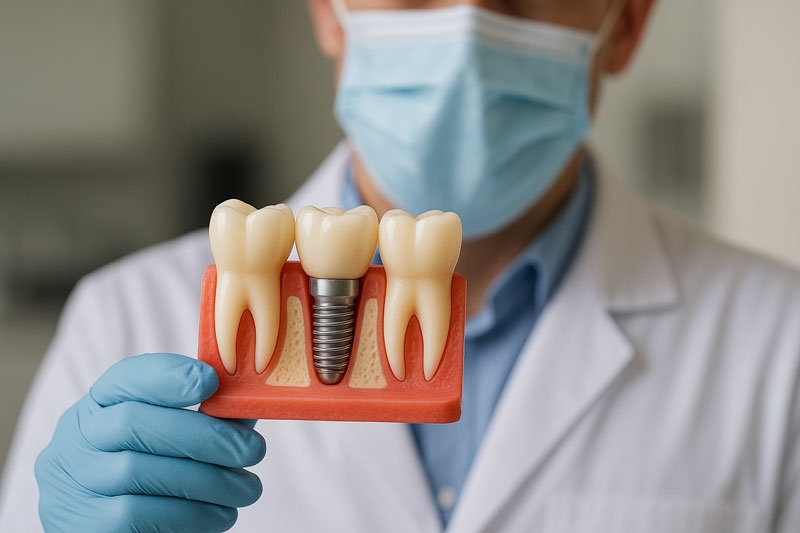
A typical single-tooth implant has three major components:
- The implant fixture placed into the jawbone
- The abutment connecting the implant to the restoration
- The dental crown that replaces the visible tooth
Patients who want a more detailed explanation can review our guide to the dental implant procedure.
How Do Dental Implants Replace Missing Teeth?
After an implant is placed, the surrounding bone gradually heals around its surface in a process called osseointegration.
Once the implant has developed sufficient stability, a crown or another restoration can be attached.
The result is a tooth replacement that is anchored directly into the jaw rather than resting on the gums or relying on neighboring teeth.
This stability is one of the main reasons patients consider dental implants for missing teeth.
What Are the Benefits of Dental Implants for Missing Teeth?
Dental implants can provide several important advantages.
They Replace the Missing Tooth Root
Unlike a bridge or removable denture, an implant replaces the root portion of the missing tooth.
This allows chewing forces to be transferred into the jawbone.
They Do Not Depend on Neighboring Teeth
A single implant usually does not require healthy teeth on either side of the gap to be reshaped.
They Can Feel More Like Natural Teeth
Because an implant is anchored in the jawbone, it can provide strong stability during chewing.
They Are Fixed in Place
A single dental implant does not need to be removed for cleaning.
Patients brush and floss around it as part of their normal oral hygiene routine.
They Can Be Long-Lasting
Dental implants are designed as a long-term tooth replacement solution.
The American Academy of Implant Dentistry notes that dental implants can provide a predictable option for replacing missing teeth when patients are appropriately selected and properly maintained. Learn more from the American Academy of Implant Dentistry.
They Can Restore Appearance
The implant crown is designed to coordinate with surrounding teeth in shape, size, and color.
What Is a Single Tooth Implant?
A single tooth implant replaces one missing tooth without relying on the neighboring teeth for support.
The implant acts as the replacement root, while a custom dental crown restores the visible portion of the tooth.
Single implants may be especially useful when:
- One tooth has been lost because of decay or trauma
- A tooth cannot be predictably restored
- Neighboring teeth are healthy
- The patient has adequate bone or can receive grafting
- A fixed replacement is preferred
For patients missing several teeth, different dental implant treatment options may be more appropriate.
Dental Implant vs. Bridge: Which Is Better?
A dental implant and a dental bridge can both replace a missing tooth, but they work differently.
| Dental Implant | Dental Bridge |
|---|---|
| Replaces the tooth root and crown | Replaces the visible missing tooth |
| Anchored in the jawbone | Supported by neighboring teeth |
| Usually does not require reshaping adjacent healthy teeth | Often requires adjacent teeth to be prepared for crowns |
| Helps stimulate bone around the implant | Does not replace the missing root |
| Requires implant surgery | Usually does not require implant surgery |
| Healing time may be required | Treatment can sometimes be completed faster |
Neither solution is automatically right for every patient.
A bridge may make sense when neighboring teeth already need crowns or when implant surgery is not appropriate. An implant may be preferable when the neighboring teeth are healthy and sufficient bone is available.
Implant vs. Bridge Summary: A bridge uses neighboring teeth for support. A dental implant is independently supported by the jawbone. The best option depends on the health of the surrounding teeth, bone availability, treatment goals, and budget.
Dental Implant vs. Partial Denture
A removable partial denture can replace one or several missing teeth without surgery.
For some patients, this provides an affordable and relatively quick solution.
However, a partial denture differs significantly from an implant.
A partial denture:
- Is removable
- May use clasps or other attachments for support
- Can move slightly during eating
- Does not replace the tooth root
- May require adjustments as the mouth changes
A dental implant:
- Is fixed in place
- Is anchored in the jawbone
- Does not require adhesives
- Helps stimulate the surrounding bone
- Can closely mimic the function of a natural tooth
Patients missing many or all teeth may also have options beyond conventional dentures, including full mouth dental implants.
What Is the Best Option for a Missing Tooth?
For many patients, a dental implant is an excellent long-term solution, but there is no universal “best” replacement.
Your dentist should consider:
- The location of the missing tooth
- The condition of neighboring teeth
- Jawbone volume
- Gum health
- Overall health
- Smoking or tobacco use
- Bite forces
- Number of missing teeth
- Desired treatment timeline
- Budget and financing considerations
A personalized evaluation is more useful than selecting a treatment based only on price or online comparisons.
Can You Leave a Missing Tooth Alone?
Technically, yes, but it may not always be advisable.
Some patients can function with a missing tooth for years. However, leaving the space untreated may allow surrounding teeth to shift and bone to gradually change.
Whether replacement is necessary depends partly on where the tooth was located and the patient’s overall bite.
For example, the consequences of losing a back molar may differ from losing a front tooth.
The best approach is to have the area evaluated so you understand both the immediate and long-term implications.
How Soon Should You Replace a Missing Tooth?
There is no single timeline that applies to every patient.
In some cases, a dental implant can be placed at or near the time a tooth is extracted.
In other situations, the extraction site may need time to heal before implant placement.
Patients who require bone grafting may need additional healing time.
Early evaluation is helpful because significant bone loss or tooth movement can make later treatment more complex.
Can a Dental Implant Be Placed Immediately After an Extraction?
Sometimes.
Immediate implant placement means the implant is positioned during the same appointment in which a tooth is removed.
Whether this is appropriate depends on factors such as:
- Infection
- Bone quality
- Bone volume
- Gum health
- Location of the tooth
- Implant stability
Patients who need an extraction can learn more about oral surgery and implant-related procedures available at New Creation Dental Care.
What If There Is Not Enough Bone for an Implant?
Having bone loss does not automatically mean you cannot receive a dental implant.
Bone grafting may be used to rebuild deficient areas of the jaw.
Depending on the location and extent of bone loss, procedures may include:
- Socket preservation
- Bone grafting
- Ridge augmentation
- Sinus lift procedures
The purpose is to create adequate support for predictable implant placement when possible.
How Long Does a Dental Implant Take?
A dental implant can involve several stages.
A typical treatment sequence may include:
- Examination and 3D imaging
- Tooth extraction if necessary
- Bone grafting if required
- Implant placement
- Healing and osseointegration
- Placement of the final crown
Healing time varies from patient to patient.
Some people can receive temporary teeth during treatment, while others need a longer healing period before the final restoration is attached.
Read our dental implant procedure guide for a more detailed explanation.
How Long Do Dental Implants Last?
Dental implants are designed as a long-term treatment.
How long an implant lasts depends on factors such as:
- Oral hygiene
- Gum health
- Smoking
- Bite forces
- Overall health
- Regular professional dental care
- The condition of the surrounding bone
The implant fixture and the crown should also be considered separately. The implant itself may remain healthy for many years, while the crown may eventually need maintenance or replacement because of normal wear.
How Do You Care for a Dental Implant?
Dental implants require ongoing hygiene just like natural teeth.
Patients should:
- Brush at least twice daily
- Clean carefully around the implant
- Floss or use appropriate interdental cleaners
- Attend routine dental visits
- Have the implant and surrounding gums professionally evaluated
- Avoid tobacco when possible
- Address teeth grinding if present
Implants cannot develop cavities, but the gum and bone surrounding an implant can still become inflamed or infected.
How Much Does It Cost to Replace a Missing Tooth?
The cost depends heavily on which tooth replacement option is selected.
Dental implants generally have a higher initial cost than removable appliances, while bridges and dentures have their own restorative and maintenance expenses.
Implant cost can also depend on:
- Extractions
- Bone grafting
- Imaging
- Sedation
- Implant placement
- Abutment
- Dental crown
- Laboratory work
For a detailed explanation of payment strategies, read our guide to dental implant costs, financing, and payment options.
Does Insurance Cover Replacing a Missing Tooth?
Dental insurance coverage varies significantly between plans.
A policy may provide benefits for portions of treatment such as:
- Extractions
- Bridges
- Dentures
- Dental crowns
- Implant treatment
- Bone grafting
Annual maximums and exclusions can affect what the patient ultimately pays.
New Creation Dental Care provides additional information about insurance and dental financing options.
Tooth Replacement Options at New Creation Dental Care
New Creation Dental Care provides several solutions for patients with missing or failing teeth in Lake St. Louis, MO.
Depending on your needs, treatment may include:
- Single dental implants
- Multiple dental implants
- Implant-supported restorations
- Full mouth dental implants
- Bone grafting
- Tooth extractions
- Other oral surgery procedures
Dr. Matthew Boscia and the New Creation Dental Care team can evaluate your teeth, gums, jawbone, bite, and overall goals to determine which tooth replacement options may be appropriate for you.
Replace a Missing Tooth and Restore Your Smile
A missing tooth does not have to become a permanent gap in your smile.
Modern tooth replacement options can restore appearance, chewing function, and stability while helping protect the surrounding mouth.
For many patients, dental implants provide a particularly attractive solution because they replace both the visible tooth and its underlying root support.
If you are missing one or more teeth, schedule a consultation with New Creation Dental Care in Lake St. Louis, MO, to compare your tooth replacement options and determine whether dental implants are right for you.